Building the Silver Layer — AUTO CDC and SCD Type 2
In the last lecture we built the bronze layer of the medallion pipeline — two append flows landing
raw Debezium CDC events into bronze_orders_cdc and bronze_customers_cdc, untouched. Now we
extend the same pipeline with a silver layer: this is where the actual CDC merge logic happens.
Add a new file to the transformations folder — silver.py — for all silver-layer flows, keeping
the one-file-per-layer structure established in the bronze lecture.
What Silver Needs to Do
AUTO CDC reads CDC events from a bronze streaming table and applies them to a silver streaming table. Applying them means resolving inserts, updates, and deletes into a coherent current state — and, in this case, doing it with full history preserved via SCD Type 2.
Recall from the core-concepts lecture: AUTO CDC is always created using explicit syntax — there's no implicit form. That means two steps for each table: create the streaming table target, then define the AUTO CDC flow into it.
Silver Orders
Step 1 — declare the target table
pythondp.create_streaming_table( name="silver_orders", comment="SCD Type 2 history of order CDC events from Bronze", expect_all_or_drop={ "valid_order_id": "order_id IS NOT NULL", "valid_customer_id": "customer_id IS NOT NULL", "valid_amount": "amount > 0" } )
Silver's job is to guard data quality, so unlike bronze — which barely used any expectations —
silver defines three, and uses expect_all_or_drop: every rule must be satisfied, or the record
doesn't make it into silver at all. Here, that means order_id and customer_id must both be
non-null, and amount must be a genuine positive value.
Step 2 — define the AUTO CDC flow
pythondp.create_auto_cdc_flow( target = "silver_orders", source = "bronze_orders_cdc", keys = ["order_id"], sequence_by = "ts_ms", apply_as_deletes = "op = 'd' or __deleted = 'true'", stored_as_scd_type = "2", except_column_list = ["_ingest_timestamp", "_source_file", "__deleted", "op", "ts_ms"] )
A few parameters worth reading carefully:
keys— the primary key(s) AUTO CDC merges on. Here,order_idalone is sufficient: matched records are treated as updates, unmatched ones as inserts.sequence_by—ts_ms, the Debezium processing timestamp. Since CDC tools can produce out-of-order records (network latency, retries, and similar issues), this tells AUTO CDC how to resolve which version of a record is actually the latest, regardless of arrival order.apply_as_deletes— after a record matches on the merge key, AUTO CDC still needs to know whether that match represents an update or a delete. This condition —op = 'd' or __deleted = 'true'— covers both the Debeziumopfield convention and the flattening SMT's__deletedconvention, so either signal is honored.stored_as_scd_type—"2", meaning full history is preserved rather than overwritten in place.except_column_list— bronze carries several columns that don't belong in a business-facing silver table:_ingest_timestampand_source_fileare bronze-specific metadata, and__deleted,op,ts_msare CDC mechanics that silver has already consumed and doesn't need to expose downstream. Excluding them keepssilver_ordersrepresenting just the orders themselves.
One important mechanical detail from stored_as_scd_type = "2": SCD Type 2 automatically adds two
columns to the table — __START_AT and __END_AT. A row where __END_AT IS NULL is the current
version of that record; a row where __END_AT IS NOT NULL is a historical version that's since been
superseded. This is exactly the filter pattern used in later gold-layer queries (__END_AT IS NULL)
to select only current records.
Silver Customers
Same two-step shape, same logic, different table:
pythondp.create_streaming_table( name="silver_customers", comment="SCD Type 2 history of customer CDC events from Bronze", expect_all_or_drop={ "valid_customer_id": "customer_id IS NOT NULL", "valid_name": "customer_name IS NOT NULL", } ) dp.create_auto_cdc_flow( target = "silver_customers", source = "bronze_customers_cdc", keys = ["customer_id"], sequence_by = "ts_ms", apply_as_deletes = "op = 'd' OR __deleted = 'true'", stored_as_scd_type = "2", except_column_list = ["_ingest_timestamp", "_source_file", "__deleted", "op", "ts_ms"], )
The only meaningful differences: the merge key is customer_id instead of order_id, the source is
bronze_customers_cdc, and the quality rules check customer_id and customer_name instead of
order-specific fields. Everything else — the sequencing, the delete detection, the SCD type, the
excluded columns — follows the exact same pattern.
Running It
Running silver.py on its own (via "Run file," since gold doesn't exist yet) updates the pipeline
graph to show something new: an actual connection between layers.
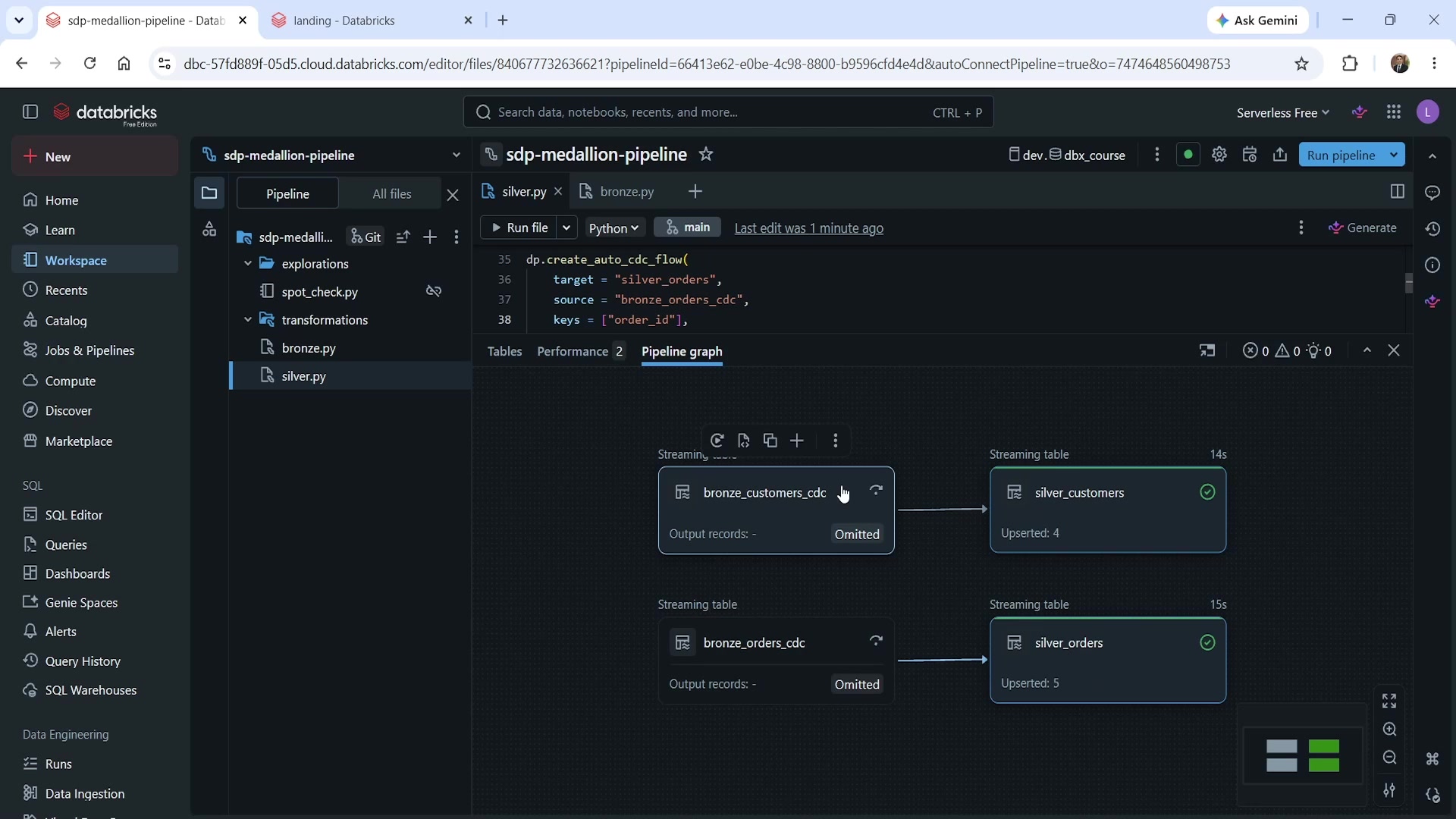 Pipeline graph — bronze feeding silver via AUTO CDC
bronze_customers_cdc now visibly flows into silver_customers, and bronze_orders_cdc into
silver_orders — with an arrow between them showing the actual lineage, rather than the disconnected
nodes bronze produced on its own. silver_customers shows Upserted: 4, and silver_orders shows
Upserted: 5 — matching the row counts already sitting in bronze from the last lecture. Since
"Run file" only executes the flows defined in silver.py, the bronze nodes here show "Omitted" for
output records — they weren't re-run, silver just read their existing table state.
Running the entire pipeline (bronze and silver together, via "Run pipeline" rather than "Run file") is worth doing too, as a sanity check. With no new files added to the landing volume since the last run, every table reports zero new records — which is exactly correct. Auto Loader and AUTO CDC are both fully incremental: with nothing new in the landing zone, there's nothing to reprocess, regardless of how many times the pipeline runs.
Summary
| Concept | Key point |
|---|---|
| AUTO CDC syntax | Always explicit — create_streaming_table() + create_auto_cdc_flow(), never implicit |
keys | The merge key(s); matched = update, unmatched = insert |
sequence_by | Resolves out-of-order events — here, Debezium's ts_ms |
apply_as_deletes | Distinguishes a delete from an update after the merge key already matched |
stored_as_scd_type = "2" | Preserves full history; adds __START_AT / __END_AT automatically |
__END_AT IS NULL | The filter for "current version of this record" — used again in gold-layer queries |
except_column_list | Strips bronze-only metadata and consumed CDC mechanics before exposing the table downstream |
| Silver expectations | Unlike bronze, silver uses expect_all_or_drop — every rule must pass, or the row is dropped entirely |
| Pipeline graph | Now shows real lineage (bronze → silver) instead of isolated nodes |
| Incremental behavior | Re-running with no new source files correctly produces zero new records everywhere |
We now have bronze and silver working end-to-end, tested independently and together. Next lecture, we add the gold layer and complete the pipeline.
See you again. Keep learning, and keep growing!