Designing the Gold Layer
In the previous two lectures, we built Bronze (raw, unfiltered preservation) and Silver (cleaned, typed, deduplicated, trustworthy data). In this lecture, let's build the final layer — Gold — where all of that becomes an actual business answer.
Design Principle: Answer a Specific Business Question
Everything in Bronze and Silver was about correctness and preservation. Gold is about speed and usability.
Gold tables are pre-aggregated, read-optimized, and built for a specific consumer — a BI tool, a dashboard, a weekly business report.
The Design Question: Table or View?
Every Gold table forces you to make a decision: should this be a materialized table, or a view?
- A view is simpler — it just wraps the Silver query. Every time someone queries it, the underlying computation runs fresh.
- A materialized table stores the actual result. Querying it just reads pre-computed data — fast, but it needs to be refreshed whenever the underlying data changes.
The right answer depends on query frequency and computation cost:
- If a Gold metric is queried hundreds of times a day, and the underlying Silver join is expensive, materialize it.
- If it's queried once a day, and Silver is fast, a view is perfectly fine.
We'll build this one as a materialized table, because that's the production-realistic choice for a revenue metric — something likely to be queried frequently, by multiple dashboards and reports.
Step 1: Build the Gold Table
sql%sql -- Gold: daily revenue by customer tier -- Business rule: only completed orders count as revenue -- This filter is a documented Gold decision, not a Silver contract DROP TABLE IF EXISTS dev.dbx_course.gold_daily_revenue; CREATE TABLE dev.dbx_course.gold_daily_revenue AS SELECT o.order_date, c.tier AS customer_tier, COUNT(DISTINCT o.order_id) AS order_count, COUNT(DISTINCT o.customer_id) AS unique_customers, SUM(o.order_total) AS total_revenue, ROUND(AVG(o.order_total), 2) AS avg_order_value, CURRENT_TIMESTAMP() AS last_refreshed FROM dev.dbx_course.silver_orders o JOIN dev.dbx_course.silver_customers c ON o.customer_id = c.customer_id WHERE o.status = 'completed' GROUP BY o.order_date, c.tier ORDER BY o.order_date, c.tier;
Let's look at what this table actually does:
- Joins Silver orders with Silver customers — pulling in the customer's tier, which lives in a separate table.
- Aggregates — counts distinct orders, counts distinct customers, sums total revenue, and computes average order value, all grouped by
order_dateandcustomer_tier. last_refreshed— a timestamp column recording exactly when this table was last built. Genuinely useful in production, so anyone looking at this table can immediately tell how fresh (or stale) the numbers are.WHERE o.status = 'completed'— this is the detail worth pausing on.
Step 2: Verify the Result
sql%sql SELECT * FROM dev.dbx_course.gold_daily_revenue;
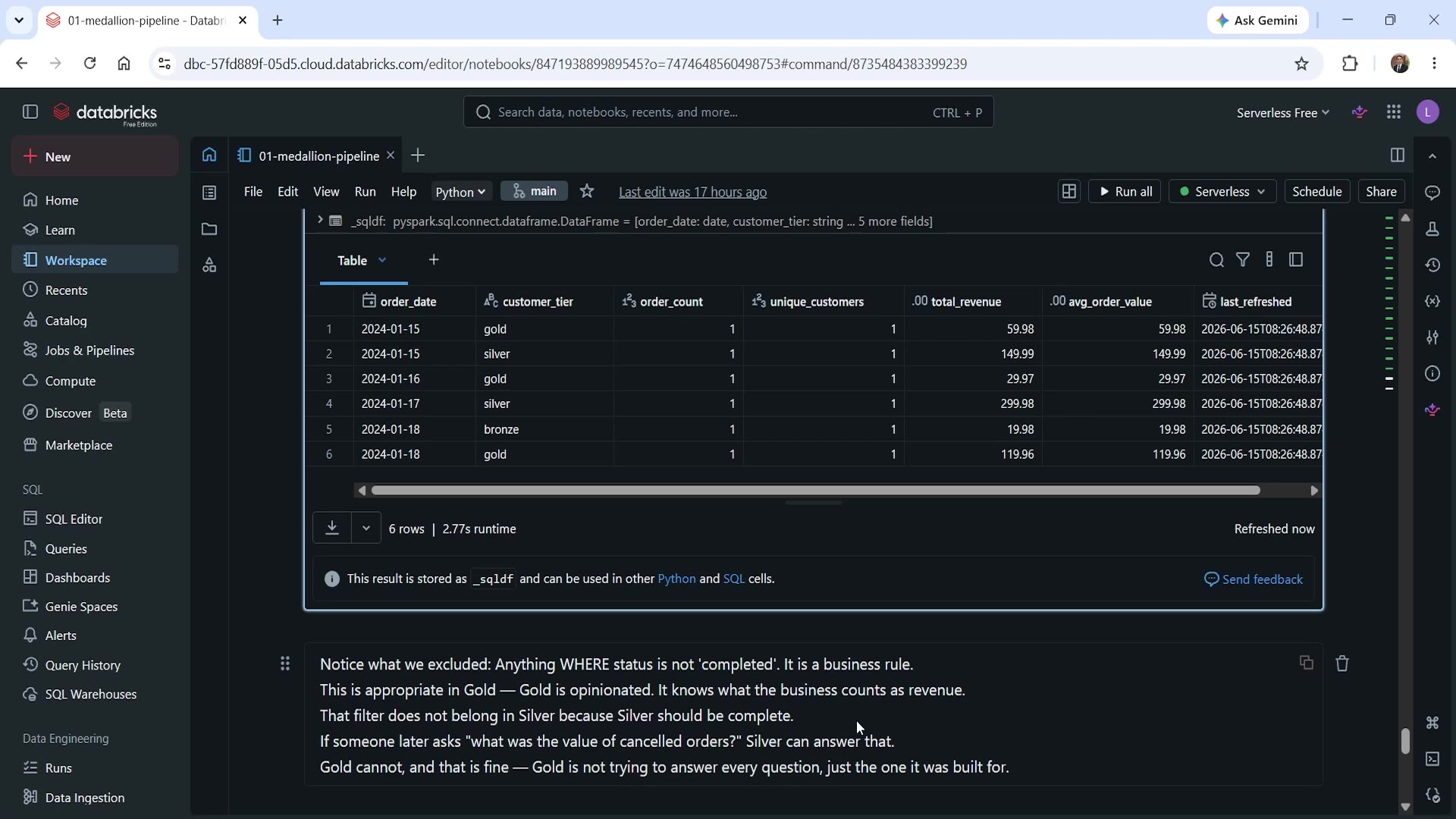 Gold daily revenue result table
The result: 6 rows, one per unique order_date + customer_tier combination, each with its order count, unique customer count, total revenue, and average order value.
Why WHERE status = 'completed' Belongs in Gold — Not Silver
This is the single most important design lesson in this lecture, so it's worth spelling out clearly.
Notice what we excluded: anything WHERE status is not 'completed'. This is a business rule — a decision about what counts as "real" revenue.
This filter is appropriate in Gold, and only in Gold, because:
- Gold is opinionated. It knows exactly what the business counts as revenue — in this case, only completed orders.
- That filter does not belong in Silver, because Silver should be complete. Silver's job is to be a trustworthy, full representation of the (cleaned) data — not to pre-decide which subset of it matters for one particular business question.
- If someone later asks "what was the value of cancelled orders?" — Silver can answer that, because it still has every status, cleaned and intact. Gold cannot answer that question, and that's completely fine — Gold was never trying to answer every question. It was built to answer one question well: daily revenue by tier.
This is exactly the Medallion contract we covered in the very first lecture of this chapter, now shown in a concrete, working example: Silver stays complete and neutral; Gold makes deliberate, documented, business-specific decisions on top of it.
Alternative: Gold as a View
For comparison, here's the same logic built as a view instead of a materialized table:
sql%sql -- Alternative: Gold as a view -- Always current, no refresh required, re-runs the query on every call -- Choose this when data freshness matters more than query speed DROP VIEW IF EXISTS dev.dbx_course.gold_daily_revenue_view; CREATE VIEW dev.dbx_course.gold_daily_revenue_view AS SELECT o.order_date, c.tier AS customer_tier, COUNT(DISTINCT o.order_id) AS order_count, COUNT(DISTINCT o.customer_id) AS unique_customers, SUM(o.order_total) AS total_revenue, ROUND(AVG(o.order_total), 2) AS avg_order_value FROM dev.dbx_course.silver_orders o JOIN dev.dbx_course.silver_customers c ON o.customer_id = c.customer_id WHERE o.status = 'completed' GROUP BY o.order_date, c.tier;
sql%sql SELECT * FROM dev.dbx_course.gold_daily_revenue_view ORDER BY order_date, customer_tier;
Notice: identical query logic, same result — but this version has no last_refreshed column, and doesn't need one. A view is always current, because it re-runs the underlying query on every single call. There's no "staleness" to track, because there's no stored, cached result to go stale in the first place.
Choose a view over a table when data freshness matters more than query speed — the trade-off being that every query against a view repeats the full join-and-aggregate computation, every time.
Summary
| Decision | Materialized Table | View |
|---|---|---|
| Storage | Stores the actual computed result | Just stores the query definition |
| Freshness | Only as fresh as its last refresh | Always current — recomputed on every query |
| Speed | Fast — reads pre-computed data | Slower — recomputes on every call |
| Best for | Frequently-queried, expensive aggregations | Infrequently-queried, or already-fast underlying data |
| Needs a refresh column? | Yes (e.g., last_refreshed) | No — never goes stale |
The core lesson of Gold: it's allowed to be opinionated. Business rules like "only completed orders count as revenue" belong here, clearly documented as a Gold-layer decision — never smuggled into Silver, where they'd quietly narrow what Silver is supposed to represent.
With Bronze, Silver, and Gold now all built, our Medallion pipeline is complete — a full journey from raw, duplicate-laden source data to a clean, business-ready revenue table.
See you again. Keep learning, and keep growing!